

What Can Fix Our Broken Schools?
This is a question that haunts most of us, at least those who are not fooling themselves into believing ALL IS OKAY...
Or that all will be okay with more money and mandates.
The (elementary) public school system can be fixed
when these things happen:
-
Class sizes are adjusted to reflect differentiated instruction. Years ago, the only thing that mattered was that a teacher delivered the necessary information and provided feedback in the form of grades. The students were responsible for absorbing that information. There was no expectation that teachers would develop individual learning plans for every student. Today, every elementary teacher is expected to do just that. Do you think that is possible, in a classroom with a ratio of even 20:1, let alone the usual ratio of 30 or more to one?
-
Students are placed in classrooms according to aptitude and achievement, and their placements are fluid.
That is a non-starter with both the education elites and the teachers’ unions. Students are purposely placed in mixed groups of high, medium, and low intellects, as well as high, medium, and low behaviors. This is to make teaching equitable for the teachers, a brain child of the unions. How does this help students?
Additionally, education researchers have been claiming for years that mixed-ability groups work for all students. The gifted can help the non-gifted, and everyone wins. The trouble is that the research this comes from is conducted in controlled settings. That’s not how real classrooms work. In my experience, the gifted students languish in mixed-ability classrooms because their teacher is not trained to work especially with them. In a purposely-mixed sixth grade classroom, the levels of ability could range from first grade to eighth grade. Who could effectively teach 30 children in that scenario?
-
Testing counts more for the students than it does for the teachers. Sure, let’s keep testing kids annually with our state exams. But put the onus on the children, letting them know that their results will be used to place them in classes according to their need. Besides, do you really think every kid takes a test earnestly? They know nothing is riding on the test for them, so if they’re tired, lazy, or just don’t care about your test, they go through the motions, clicking from screen to screen and waiting awhile before selecting their answer, whether they read the passage or not. You should see some of the questions a fourth-grader is expected to answer, based on the Common Core standards. You can find released test items on the internet if you’re interested, but I’ll make it easy for you by posting a link here for a practice test on a passage about happiness. Scroll down a little and you’ll see it. Look for the orange title “Reading Practice Test – 4 (Reading Comprehension)”
-
Teachers are hired for their ability to teach. Seems like a no-brainer, but teachers are not hired for a demonstrated ability to teach. They’re hired based on how they were able to BS their way through an interview, or whether they somehow had an ‘in’ with the principal. Competence does not enter the equation. I heard a pundit on TV say recently that there are plenty of people who love their job but are just not good at it. That applies to a lot of teachers. Many love their job, but they aren’t good at being a teacher. I work with one of those now; she loves her students, provides plenty of opportunities for enrichment in her classroom, nurtures their dreams, feeds them snacks, shows them videos. But she doesn’t teach phonics, vocabulary, or basic sentence structure. She thinks her primary job is assisting her students’ social/emotional growth. She’s in charge of a 2nd/3rd grade combo class, and she’s not teaching her students how to sound out words and make sense of groups of words, or how to write complete sentences. As a result, I get 4th graders who cannot read or write.
-
Achievement among students is once again celebrated. Today, academic “growth” is considered more important than achievement. Twenty years ago, I would have said you’re crazy if you think this could ever happen. But 12 years ago, it started in Colorado. Our principal shared the bullet points of the Every Student Succeeds Act (2009), which celebrates and measures growth over grade-level achievement, and told us we need to get on that bandwagon. It’s been downhill ever since. (You can read a lot more about how growth has tainted education over the last decade in my book Chaos in Our Schools.)
-
Teacher evaluation systems rely on watching a teacher teach rather than on reading the teacher’s documentation about how she is teaching. When do you think the teacher is doing this documenting? At home in the evening, on her time? Probably not. At my former school in Colorado, our principal made it clear to his teachers that if it wasn’t written down, it didn’t happen. He said that documenting what we were doing to differentiate for our students was the best thing we could do for our careers. That is mind-blowing. I thought the best thing I could do for my career was teach my students the material I was responsible for teaching. Sooner or later, teachers realize that the documentation is the only thing that matters. No one can prove you didn’t work with that small group on their vocabulary list, using strategies you found in a manual in the breakroom. So what if it isn’t true. Your principal has no grounds on which to refute it, even if he suspects you’re full of $#!t.
Here’s a glimpse at what the School Matters Foundation proposes to combat the sad state of learning in America:
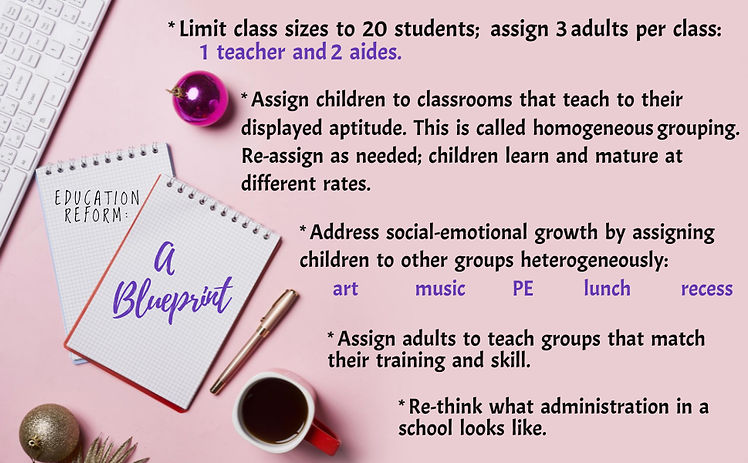
You can read the full plan in chapter 18 of
CHAOS in our schools.

